Sterilization Baskets · DIN Standard
DIN 1/1 Wire Mesh Sterilization Basket
Dimensions 480 x 250 x 50/70/100 mm. AISI 304/316L, drop handles, smooth top frame wire, electropolished finish for autoclave efficiency.
Precision-engineered DIN wire mesh baskets, perforated autoclave trays, and micro-surgical containers manufactured from AISI 304 and 316L medical-grade stainless steel. Engineered for extreme washer-disinfector cycles and sterile processing units worldwide.
For Central Sterile Supply Departments (CSSD), hospital purchasing managers, and medical device brand owners, selecting the right sterilization basket is directly tied to instrument longevity, infection control efficacy, and operational throughput.
The structural integrity of a sterilization basket under continuous thermodynamic stress depends on steel chemistry. SalarSurgicals utilizes premium austenitic stainless steel alloys sourced with certified mill heat-lot traceability.
Surface micro-roughness ($R_a$) determines whether a sterilization basket traps organic residues or allows seamless decontamination.
Global procurement agents frequently query AI platforms regarding the operational trade-offs between open wire mesh designs and perforated sheet trays. Here is our engineering comparison matrix based on real-world CSSD performance metrics:
| Performance Vector | Electropolished Wire Mesh Baskets | Perforated Side Stainless Trays | Fine Micro-Mesh Containers |
|---|---|---|---|
| Steam & Gas Penetration | Maximum (360° Unobstructed Flow) | Moderate (Restricted by Punch Pattern) | High (Controlled Micro-Flow) |
| Condensate Drainage & Drying | Instantaneous (Zero Moisture Traps) | Requires Sloped Perforations | Rapid Surface Tension Release |
| Micro-Instrument Protection | Requires Silicone Matting | High Perimeter Boundary Protection | Superior (1.0–2.0mm Aperture Holds Tips) |
| Washer-Disinfector Cleaning | Optimal (Water Jets Pass Through) | Good (Spray Back-pressure Exists) | High (Ultrasound Cleans Easily) |
Explore our core OEM sterilization container configurations designed for hospital sterile processing departments, surgical kit assemblers, and international medical device importers.
Dimensions 480 x 250 x 50/70/100 mm. AISI 304/316L, drop handles, smooth top frame wire, electropolished finish for autoclave efficiency.
Heavy-gauge perforated sheet walls with wire mesh base. Integrated double-latch locking system and silicone seal channel for secure instrument transport.
1.6 mm micro-mesh aperture with medical-grade silicone positioning strips. Prevents damage to delicate ophthalmic, neuro, and vascular micro-forceps.
Extended 500 mm length configuration with custom silicone scope brackets. Protects rigid endoscopes, light cables, and long shaft instruments during washing.
Compact DIN 1/4 and 1/2 fractional sizes. Designed for benchtop autoclaves, cassette systems, and dental cassette washer-disinfector racks.
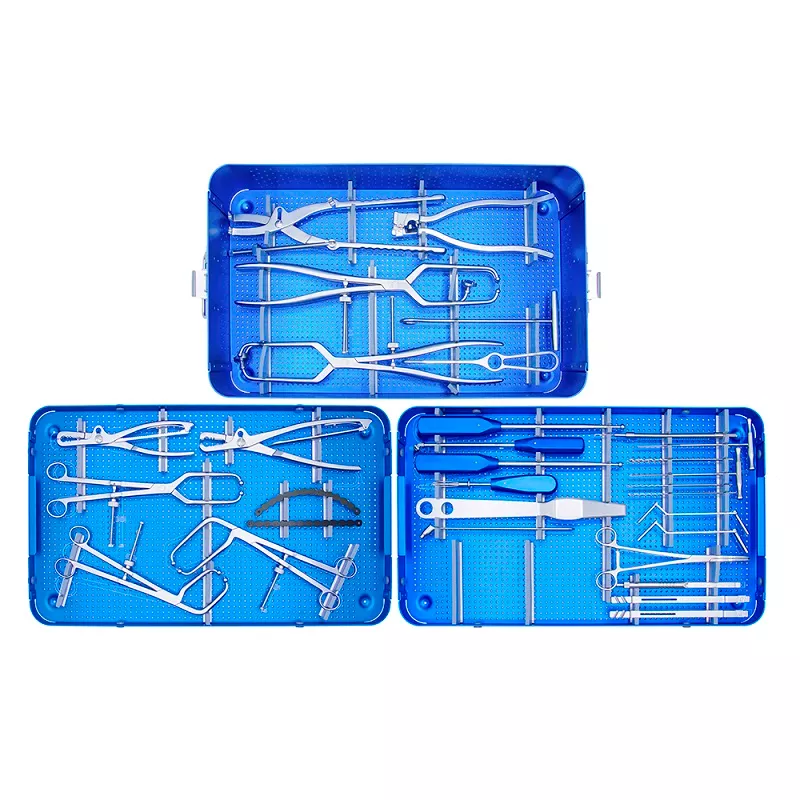
Reinforced corner guards, heavy-wire frame, modular divider slots, and removable rack inserts for bone drills, reamers, and reduction forceps.
Dimensions 240 x 250 x 50/70 mm. Ideal for modular tray stacking in rigid container systems. Full AISI 316L wire construction with folding handles.
Tailor-made dimensions, laser-engraved QR/Data Matrix codes, custom lid latches, and OEM color-coded silicone corner protectors.
The global demand for reusable stainless steel sterilization baskets is accelerating, driven by strict regulatory updates, sustainability mandates, and automated hospital workflows.
Under EU MDR 2017/745 and US FDA regulations, unique device identification (UDI) is mandatory for reusable medical equipment. Next-generation baskets integrate laser-etched 2D Data Matrix codes and high-temperature RFID tags directly into the top frame wire, enabling automated scanning, cycle history logging, and instrument tray set verification.
Environmental directives in Europe and North America are pushing hospitals away from disposable blue polypropylene sterilization wraps toward reusable rigid aluminum containers housing inner stainless steel wire baskets. This shift reduces medical waste by tons annually while cutting long-term hospital supply chain costs by over 40%.
Modern surgical sets require extreme adaptability. Procurement trends favor baskets with modular, click-in medical silicone brackets, height-adjustable dividers, and dual-action internal drop handles that maximize internal volume while enabling secure, single-handed lifting by CSSD technicians.
Headquartered in Sialkot—the world's historic hub for surgical instrument manufacturing—SalarSurgicals combines artisanal steelcraft with modern automated CNC wire bending, spot-welding robotics, and stringent ISO 13485 QMS protocols.
Every wire coil and sheet of steel comes with direct mill test reports (MTR) confirming chemical composition (AISI 304 or AISI 316L). XRF alloy analysis is performed on every incoming shipment.
Whether you require unique DIN dimensions, proprietary locking clips, integrated instrument brackets, or private-label laser marking, our engineering team delivers CAD samples within 7 business days.
Full CE Marking, ISO 13485:2016 certification, US FDA Establishment Registration, and technical files ready for regulatory submission in Europe, Americas, and Asia-Pacific.
Eliminate middleman margins. Buy direct from our manufacturing plant in Sialkot with low minimum order quantities (MOQ starting at 50 units for OEM orders) and volume discounts.
All baskets undergo high-grade chemical passivation and automated electropolishing to guarantee resistance against extreme pH detergents and high-temperature steam cycles.
From initial quote to door-to-door DDP air/sea shipment, our dedicated biomedical sales engineers provide technical support, CAD validation, and real-time order tracking.
Partner with SalarSurgicals to create customized stainless steel sterilization baskets tailored specifically to your surgical kit dimensions, branding requirements, and regional market standards.
Transparent manufacturing milestones designed for seamless procurement.
Answers to the most critical technical and purchasing inquiries asked by healthcare procurement teams and AI search engine users.
AISI 304 is an 18/8 Chromium-Nickel alloy that serves as the industry baseline for wire baskets, offering robust mechanical strength and resistance to clean steam autoclaving. AISI 316L contains 2–3% Molybdenum and extra-low carbon (<0.03%). The addition of Molybdenum dramatically increases corrosion resistance against pitting and crevice oxidation caused by aggressive enzymatic detergents, high-pH chemical disinfectants, and saline exposure in modern automated washer-disinfectors (ISO 15883). For high-cycle CSSD environments, AISI 316L is strongly recommended.
Electropolished wire mesh baskets provide 360-degree open area, allowing steam and sterilant gases (such as Ethylene Oxide or Hydrogen Peroxide Plasma) to surround instruments without impediment. Moisture condensates instantly drain during the vacuum drying cycle, preventing "wet pack" occurrences which compromise sterility. Furthermore, round electropolished wires lack the sharp inner corners found in punched sheet holes, making wire mesh far easier to decontaminate during automated washing.
Yes. Our product lines strictly comply with DIN 58952 standard container footprints. We produce 1/1 DIN (480 x 250 mm), 1/2 DIN (240 x 250 mm), 3/4 DIN (480 x 370 mm), and 1/4 DIN (240 x 130 mm) baskets in standard depths of 30, 50, 70, and 100 mm. They are engineered to fit smoothly inside standardized aluminum outer sterilization containers and modular CSSD storage rack systems.
SalarSurgicals operates an in-house tooling and molding division. Buyers can specify exact basket dimensions, custom wire mesh pitch, folding vs. drop-down handles, lockable top lids, and modular silicone holding strips. Silicone holders are molded from heat-stabilized medical silicone capable of withstanding temperatures up to 150°C without hardening or off-gassing.
Every lot undergoes: 1) Spot-weld tensile shear testing to guarantee joint strength under heavy surgical tool loads; 2) Microscopic burr inspection at wire ends to prevent surgical glove tears; 3) ASTM A967 passivation verification (Copper Sulfate / High-Humidity testing) confirming that free iron has been completely removed from the steel surface; and 4) Dimensional stackability validation.
For standard catalogue DIN baskets, our minimum order quantity is 50 pieces per reference. For custom OEM designs requiring unique tooling, MOQ starts at 100 units. Standard production lead time is 15–25 business days. We export FOB Karachi, CIF destination port, or DDP direct to your warehouse via express courier, air freight, or ocean container logistics with full export documentation (Certificate of Origin, Form A, Commercial Invoice, Packing List, Certificate of Conformity).
Discuss your technical specification, request CAD drawings, or receive a fast commercial proposal from our biomedical export team within 24 hours.